
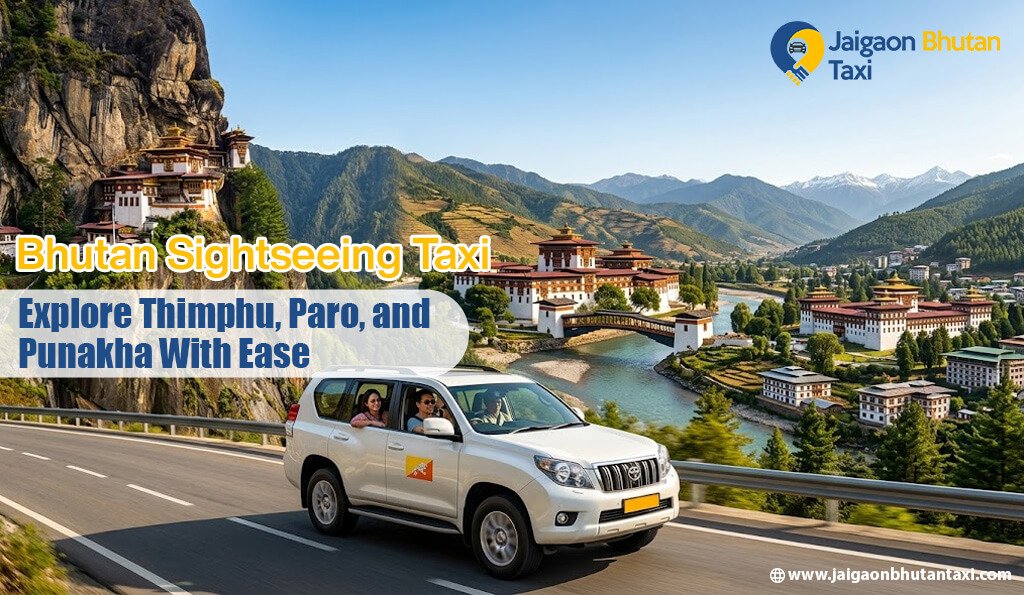
Almost everyone planning a Bhutan trip from the Indian side asks the same question first: how do you actually get around once you’re there? Not what to see, not where to stay – just, how do you move from one place to the next without losing half the trip to logistics.
Fair question, too. Bhutan isn’t a place where you step out and grab a cab off the street. There’s no metro, no ride-hailing app, and the buses run on their own schedule that has nothing to do with when a traveler wants to see something. So the transport question ends up mattering more than most people expect before they go.
Confusion at the Jaigaon border is common enough that it’s worth addressing head-on. Travelers cross over not sure what happens next, when a Bhutan sightseeing taxi booked in advance would sort the whole thing out before they even leave home.
Why a Taxi, Specifically
Public buses run between Phuentsholing, Thimphu, Paro, and Punakha, and some travelers do use them. But buses don’t stop because someone wants a photo of the valley, and they don’t wait around while a group spends forty minutes wandering through a dzong.
A private driver does. And that’s really the point of hiring one – not just comfort, though the comfort helps. It’s about not missing the moment when the road opens up and the mountains come into view, because a driver who’s done the route a hundred times already knows where people stop and slows down without being asked.
On the Thimphu-Punakha road, drivers routinely pull over right at Dochula Pass, unprompted, because they know exactly where the view kicks in. A bus timetable doesn’t offer that.
Getting Across from Jaigaon
Most travelers coming in from India start in Jaigaon, right on the border next to Phuentsholing. This is usually where a trip either starts smoothly or starts with an hour of standing around asking strangers where to go next.
Jaigaon Bhutan Taxi handles this part directly – pickup from Jaigaon, help through the border formalities, then straight into Bhutan without switching vehicles or renegotiating a fare with someone new. Travelers who arrange things separately at each stage tend to report the same pattern: more waiting, more confusion, and somehow still more money spent than booking one driver for the whole route would have cost.
Thimphu isn't a Walking City, Whatever the Map Suggests
The drive from Phuentsholing to Thimphu takes somewhere around five to six hours, climbing through hills the entire way. It sounds long on paper. With a driver who knows when to stop and when to keep moving, it passes faster than expected.
Once in Thimphu, the sights aren’t clustered together the way a first-time visitor might hope. The Buddha Dordenma statue sits on a hillside outside the city. Tashichho Dzong is on one side of town, the weekend market somewhere else entirely, and the National Memorial Chorten a fair walk from both. Thimphu also sits at altitude, so a full day of walking between all this adds up faster than it looks like it should. A taxi that keeps the day moving between these spots without the guesswork saves more energy than it gets credit for.
Paro, and the Hike Everyone's Seen Photos of
Paro is basically synonymous with Tiger’s Nest at this point – Taktsang Monastery, perched on a cliff nine hundred meters above the valley. The photo is familiar to almost anyone who’s looked up Bhutan online. Fewer people realize a taxi ride out of town is needed just to reach the base before the hike even starts.
Paro has more to offer beyond the monastery, though. Rinpung Dzong, the National Museum, and the old wooden bridge over the river are all worth an afternoon. A good driver paces the day around the traveler instead of a fixed itinerary – early start for the hike, rest in the middle of the day, sightseeing again once it cools off in the evening. It’s a small adjustment, but it changes how the whole day feels.
Punakha, and Why it Comes up in Almost Every Conversation
Ask anyone who’s been to Bhutan what stuck with them most, and Punakha comes up almost every time. Part of that’s the drive itself – the route crosses Dochula Pass at over three thousand meters, and on a clear day the Himalayan range opens up ahead. Part of its Punakha Dzong, sitting right where two rivers meet, a building that looks better in person than in any photo of it.
The road between Thimphu and Punakha has real switchbacks, weather that changes without warning, and stretches where phone signals disappear entirely. This is where a driver who’s actually done the route matters, not just someone with a license and a car. Knowing when to push through and when to sit tight for weather to pass isn’t something worth learning on the fly.
Questions People Ask Before Booking
Does a trip need a separate taxi for every town?
Do drivers know how to handle permits?
Isn't the bus cheaper?
How long should the whole trip take?
Planning the Route
Travelers crossing from Jaigaon who don’t want to deal with switching taxis and renegotiating fares at every stop have a straightforward option – Jaigaon Bhutan Taxi – pickup right at the border, with drivers who already know the roads through Thimphu, Paro, and Punakha rather than learning them alongside the passengers.
The roads in Bhutan are half the trip. Better to spend that time looking out the window than wondering if the next driver speaks enough English to understand where the group is trying to go.